George Kent (England)


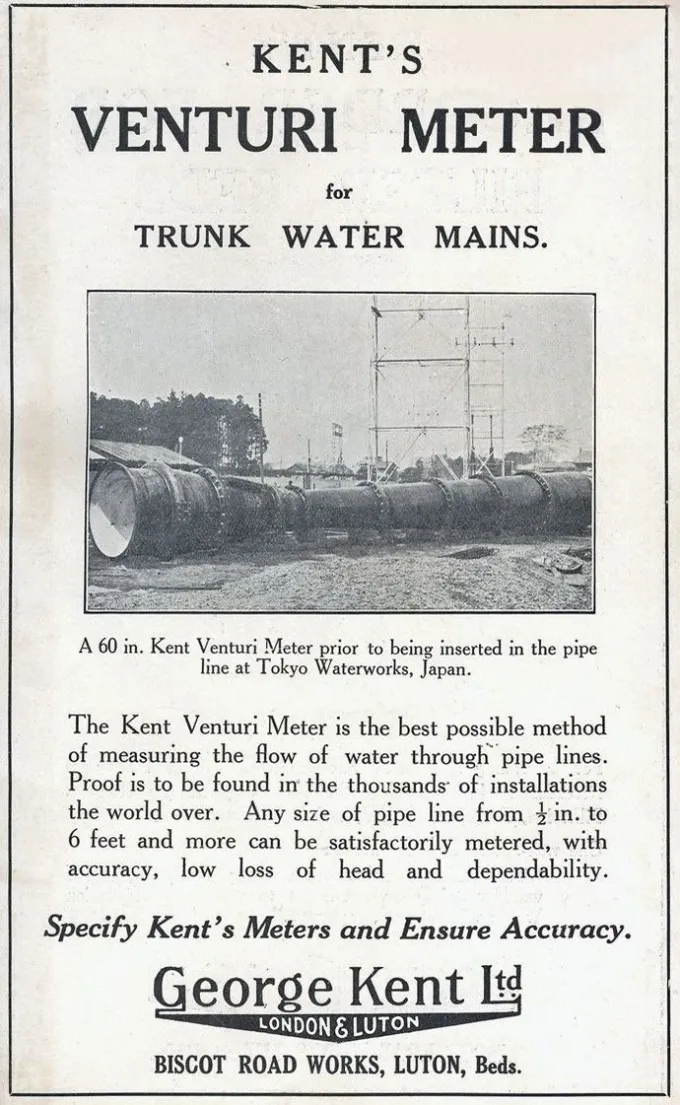
Origins of a Measurement Powerhouse (1838–1890s) Origins:- George Kent 1806-1890 and son Sir Walter George Kent 1858-1938. Kent Ltd began in 1838 at 199-201 High Holborn, London WC and then Biscot Road, Luton England as a maker of domestic gadgets before evolving into a precision‑instrument manufacturer. By the late 19th century, the company had shifted decisively toward hydraulic engineering, producing apparatus for water and sewage authorities. A surviving trade catalogue titled “From Drops to Rivers” illustrates their early ambition to measure water “under all conditions affecting the work of water and sewage engineers.” This period laid the foundation for Kent’s future dominance in industrial flow measurement. Establishing a Global Reputation (1890–1914) 1890 Patent is registered for a rotary piston water meter. By 1891, George Kent Ltd had issued a full catalogue of water meters, marking their formal entry into large‑scale metering for municipal water supply and sewerage systems. The company also produced advanced differential‑pressure recorders, such as the B‑type recorder (c. 1896), used with Venturi flow meters. These instruments employed chart drums and precision mechanisms to record pressure differentials in municipal water systems. A preserved example from Cowdenbeath Water illustrates their early adoption in UK waterworks. These devices helped engineers quantify flow in large pipelines long before electronic instrumentation existed. In 1908, the company opened a major manufacturing works in Luton, and by 1914 it employed around 450 workers, reflecting the rapid expansion of water infrastructure across the British Empire. 1907 it was Incorporated as a Limited Company. From 1914 to 1919 the company began producing a dozen types of fuses during WW1 and reached a maximum output of 130,000 fuses a week. At its height, a workforce of 8,000, mostly women, was employed on the production and filling of fuses for shells and bombs. Production ceased at wars end and the company refocused on its measurement instruments. During this era, Kent produced: Water Meters, Venturi meters, Differential‑pressure meters, Oil Meters and Early chart‑recording instruments. These devices were installed throughout the UK and abroad, forming the backbone of early 20th‑century water‑engineering practice.
.jpg@webp)

The Orivent Era: Precision and Permanence (1910s–1930s) One of George Kent’s most significant contributions was the Type A “Orivent” Water Meter Recorder, a robust chart‑recording flow meter used in pumping stations, sewerage works, and industrial plants. In 1921 the company merged with J. Blakeborough and Sons under the title of George Kent Ltd and J. Blakeborough and Sons Ltd. By 1922, George Kent Ltd had installed approximately 7,000 flow‑metering units worldwide, including in Hong Kong, India, Japan, Malaysia, and Argentina. A 1923 example from the Spotswood Sewerage Pumping Station in Melbourne Victoria demonstrates the durability and engineering refinement of these instruments. The Orivent became a global standard for continuous flow logging, prized for its reliability and mechanical elegance. Meters from this era included Venturi water meters (e.g., 1935 models), Tele-register flow recorders, Mercury‑column differential meters. These instruments were known for their longevity—many remain preserved in museums today. A Broadening Industrial Portfolio (1920s–1940s) By the interwar period, George Kent Ltd had become the largest British manufacturer of industrial control instruments, producing not only water meters but also gas meters, steam meters, oil meters and engine‑room control equipment. Their manufacturing footprint extended from Luton London, to Perth in 1906 and Sydney in 1946, and to Malaysia in 1936. The products were also well represented by distributors in the USA, reflecting the company’s global reach.


The Australian Chapter (1906 and 1946) In 1906 George Kent Co opened a Factory at Railway Street West Perth to manufacture Positive Displacement Water Meters for the Western Australia water authority. George Kent's son Walter Kent personally attended the event. This moment in history was discovered in -Trove- after deep research by Alex Manu the curator of the HWMM and the article can be viewed below. In 1946, George Kent Ltd partnered with Davies Shephard (Sydney) to license and manufacture its PD water‑meters by Davies-Kent in Mascot Sydney NSW. This joint venture localized production for the Australian market and cemented Kent’s presence in post‑war water‑infrastructure development. This move ensured that Kent’s engineering legacy continued to influence Australian water‑metering standards for decades. Legacy and Significance 1966 Kent Meters Ltd was incorporated. 1974 Acquired by Swiss company Brown, Boveri and Co and renamed ABB-Kent Meters. 2002 ABB sold its worldwide metering business to Ruhrgas Industries GmbH. The UK operating company, ABB Metering Ltd was renamed Elster Metering Ltd. In 2012 Melrose bought Elster then sold to Honeywell 2015. Today, George Kent’s water meters represent a pivotal chapter in the modernization of global water management. Their innovations: - Enabled accurate measurement of municipal water and sewerage flows - Supported the expansion of early 20th‑century urban infrastructure - Set engineering standards for durability and precision - Influenced later generations of industrial flow‑meter design. (Research by Alex Manu - 2026) The HWM-Museum has in its collection rare G.Kent items including the 1906 Hydraulic Memoranda & Formulae book and a 1940's PD water meter.


.jpg@webp "1910 Kent Hydrant flow & pressure tester kit")
